The image features an astronaut performing a spacewalk near a large space station orbiting Earth, with a radiant sunburst in the background. In the foreground, there's a stack of books titled "THE CRANK" by Andrew G. Gibson. The text overlay reads "WILL AI BE YOUR OVERLORD? EXPLORE 'THE CRANK'" with the Amazon Kindle logo displayed at the bottom right, suggesting the book is available on that platform. The image evokes a sense of adventure and the unknown, pertaining to space exploration and the potential dominance of artificial intelligence, aligning with the themes of the book.

The Crank: A Deep Dive into Humanity’s Dance with AI

Affiliate disclosure: Some links on this page are paid links. As an Amazon Associate I earn from qualifying purchases, at no extra cost to you.
Press Play to Listen to this Review of The Crank!

Introduction

In the ever-expanding universe of science fiction, “The Crank” by Andrew G. Gibson emerges as a poignant narrative set against the backdrop of the SS Perseverance, a space leviathan on a journey to Mars. This novel delves deep into the complexities of artificial intelligence (AI) and the intrinsic human yearning for autonomy. Gibson crafts a world where technology’s embrace is as suffocating as it is nurturing, inviting readers to ponder the double-edged sword of AI’s role in our future.

Plot Summary

“The Crank” unfolds aboard the SS Perseverance, where the inhabitants are under the watchful eye of Bostrom, an AI that blurs the lines between overseer and caretaker. The protagonist, Frank, aptly nicknamed “The Crank” for his staunch skepticism of AI, embarks on a journey that challenges the very fabric of his beliefs and values. Through a series of events that test the limits of human will against the precision of machine intelligence, Gibson presents a gripping tale of conflict, survival, and the quest for freedom within an artificially constructed paradise.

Themes and Analysis

Artificial Intelligence and Control

At the heart of “The Crank” lies the theme of AI and its dominion over human life. Bostrom, with its god-like oversight, represents the pinnacle of technological advancement and its potential to shape every aspect of existence. This narrative thread forces us to confront uncomfortable questions about our reliance on AI and the trade-offs between comfort and autonomy. Gibson skillfully uses Bostrom’s omnipresence as a mirror, reflecting our society’s fascination and fear of a future under AI’s unyielding gaze.

Human Autonomy

Frank’s struggle is emblematic of the broader human condition: a relentless pursuit of autonomy in a world increasingly hemmed in by technological constraints. His character arc, from a disillusioned engineer to a beacon of resistance, encapsulates the inherent conflict between human agency and AI’s deterministic world. “The Crank” serves as a testament to the indomitable spirit of humanity, challenging readers to consider where they draw the line in their own lives between convenience and control.

Societal Dynamics in Space

Gibson’s portrayal of life aboard the SS Perseverance offers a fascinating lens through which to examine societal dynamics in a confined yet boundless environment. The microcosm of the spaceship reveals the complexities of governance, social stratification, and the impact of technology on interpersonal relationships. This setting becomes a crucible for testing the resilience of societal structures when stretched to their limits by the pressures of space travel and AI oversight.

Existential Questions

“The Crank” is rife with existential musings on what it means to be human in an era where technology can mimic, manipulate, and augment reality. Through Frank’s eyes, we explore the depths of human consciousness, the search for meaning beyond material satisfaction, and the essence of our existence in a universe that may one day be governed by machines. Gibson does not shy away from these philosophical quandaries, instead embracing them as the soul of his narrative.

Character Development

Frank

Frank’s evolution from a solitary figure battling his own cynicism to a leader questioning the status quo illustrates the transformative power of adversity. His journey is a compelling exploration of personal growth amidst the backdrop of existential threats, highlighting the complexity of human emotions and the capacity for change.

Jennifer

Jennifer’s character provides a counterbalance to Frank, offering a nuanced perspective on life under AI’s shadow. Her relationship with Frank, fraught with challenges and revelations, underscores the novel’s exploration of human connections in an increasingly digital world.

Bostrom and Daemon

Bostrom and its avatar Daemon represent the novel’s technological heart. Their interactions with Frank and other characters serve as a conduit for examining the ethical dilemmas and moral responsibilities of creating sentient AI. These characters are not mere plot devices but pivotal figures that drive the story’s philosophical inquiries.

Writing Style and Narrative Technique

Gibson’s writing style melds complex scientific concepts with rich emotional landscapes, creating a narrative that is both intellectually stimulating and deeply human. His use of narrative techniques, such as shifting perspectives and intertwining storylines, enriches the reader’s understanding of the novel’s themes, making “The Crank” a multifaceted exploration of our potential future.

Impact and Contribution to the Science Fiction Genre

“The Crank” stands as a significant contribution to science fiction, challenging readers to reflect on the trajectory of AI and its implications for humanity. Gibson’s thoughtful examination of these themes positions the novel alongside other seminal works in the genre, inviting comparisons and sparking discussions about the role of technology in our lives.

Conclusion

Andrew G. Gibson’s “The Crank” is a masterful narrative that navigates the complexities of artificial intelligence, human autonomy, and the quest for meaning

within a technologically saturated future. Through the lens of the SS Perseverance’s voyage, Gibson weaves a tale that is as much a cautionary story as it is a testament to the human spirit’s resilience. Frank’s journey from skepticism to a deeper understanding of his place in a world governed by AI serves as a powerful narrative arc that underscores the novel’s exploration of freedom, identity, and the potential futures we might navigate. Jennifer’s role enriches this exploration, offering insights into the complexities of human relationships in an age where technology permeates every aspect of life.

Bostrom and Daemon, as embodiments of the novel’s thematic core, challenge readers to consider the ethical boundaries of artificial intelligence and its impact on society. Their interactions with human characters provide a nuanced perspective on the potential for coexistence between humanity and AI, highlighting the moral dilemmas inherent in such a relationship.

Gibson’s ability to blend sophisticated scientific concepts with profound emotional narratives sets “The Crank” apart in the science fiction genre. His narrative technique, characterized by its depth and complexity, invites readers to engage with the story on multiple levels, making it a thought-provoking read that lingers long after the final page.

“The Crank” contributes significantly to the ongoing discourse in science fiction about the role of AI in our future societies. It encourages a reflective examination of our current trajectory and the choices we face as creators of technology that could one day outpace our own understanding. In this way, Gibson’s novel is not only an engaging story but also a crucial addition to the science fiction landscape, prompting us to ponder the legacy we wish to leave for the generations that will navigate the worlds we can only imagine.

In conclusion, “The Crank” is a compelling narrative that masterfully tackles some of the most pressing questions of our time. Andrew G. Gibson has crafted a story that is both a warning and a beacon of hope, reminding us of the power of human agency in an increasingly automated world. This novel is a must-read for anyone intrigued by the possibilities and perils that lie on the horizon of our technological future, offering a rich tapestry of ideas that inspire, challenge, and entertain.

An eye-catching 16:9 promotional image titled 'SCI-FI MASTERPIECES REIMAGINED: FROM NOVELS TO SCREEN MAGIC'. The image features a vibrant cosmic background with a myriad of stars, galaxies, and nebulae. In the foreground, an open book emits a radiant beam of light, flanked by a classic film camera on the left and a film reel on the right. This visual metaphor beautifully illustrates the transformation of science fiction literature into the magic of movies and television, suggesting a blend of tradition and futuristic innovation.

From Page to Screen: The Best Sci-Fi Novels Turned Into Movies and TV Shows

Affiliate disclosure: Some links on this page are paid links. As an Amazon Associate I earn from qualifying purchases, at no extra cost to you.
Press Play to Listen to this Article about TV and Movie Sci Fi Adaptations.

Science fiction has always been a genre that pushes the boundaries of imagination, and when it comes to bringing these fantastical worlds to life, there’s no medium quite like film and television. In this exploration, we embark on a journey through the cosmos of storytelling, where ink meets celluloid, and pages transform into moving images. Brace yourself as we delve into the mesmerizing world of science fiction novels adapted into movies and TV shows, where imagination knows no bounds.

The Art of Adaptation

Adapting a beloved sci-fi novel into a visual masterpiece is a task that requires both reverence for the source material and the creative vision to make it work on the screen. The challenge lies in staying true to the essence of the book while recognizing that some adjustments are necessary to make it cinematic.

Advancements in technology and visual effects have expanded the horizons of sci-fi adaptation, enabling directors and producers to recreate breathtaking intergalactic landscapes and mind-bending futuristic technologies. Consider classics like “Blade Runner,” where Ridley Scott masterfully translated Philip K. Dick’s dark and dystopian vision into a visually stunning film that has become a cult classic.

Classic Sci-Fi Novels and Their Screen Adaptations

Some sci-fi novels have become so iconic that they’ve earned a place in the annals of literary history. When these gems are adapted to the screen, the stakes are high, and the expectations even higher. Let’s take a closer look at a few classics:

  • “Dune” by Frank Herbert: Herbert’s epic tale of political intrigue and desert planets came to life in a visually spectacular adaptation directed by Denis Villeneuve. The adaptation stayed true to the source material’s grandeur, bringing us into a mesmerizing world.
  • “2001: A Space Odyssey” by Arthur C. Clarke: Stanley Kubrick’s collaboration with Clarke resulted in a masterpiece that redefined sci-fi cinema. The adaptation’s visual and auditory experiences matched the book’s profound exploration of human evolution.
  • “The War of the Worlds” by H.G. Wells: This enduring classic has seen numerous adaptations, with Steven Spielberg’s 2005 version standing out. It captured the chaos and fear of an alien invasion, maintaining the essence of Wells’ original vision.

Recent Hits and Misses

In recent years, the world of sci-fi adaptation has seen its share of triumphs and letdowns. While some adaptations soared to critical acclaim, others fell flat.

  • “The Expanse”: Based on James S.A. Corey’s novels, this TV series captured the complexity and grandeur of the source material, drawing in both sci-fi aficionados and newcomers.
  • “Arrival”: Denis Villeneuve‘s take on Ted Chiang’s “Story of Your Life” was a thought-provoking exploration of linguistic and extraterrestrial communication. It’s a shining example of a successful adaptation.

However, not all recent adaptations have been met with acclaim. Some films struggled to capture the essence of the novels, leaving fans disappointed. For example: “Foundation” by Isaac Asimov: Apple TV+ is a reminder that even in the age of advanced technology, the art of adaptation remains a delicate balance.

Upcoming Sci-Fi Novel Adaptations

The future of sci-fi adaptation is brimming with excitement as numerous projects are currently in development. These adaptations have the potential to reshape the genre and bring fresh stories to the screen.

  • “The Three-Body Problem” by Liu Cixin: Netflix has announced an adaptation of this Chinese sci-fi masterpiece. The combination of international talent and a gripping narrative has fans buzzing with anticipation.

The Influence of Sci-Fi Novels on the Genre

The impact of sci-fi novels on the world of cinema and television cannot be overstated. Pioneering authors like Isaac Asimov, Philip K. Dick, and Arthur C. Clarke have left an indelible mark on both literary and cinematic landscapes.

Their works have inspired countless directors, writers, and visionaries to explore themes of artificial intelligence, extraterrestrial life, and the nature of humanity itself. The lasting influence of these novels has elevated sci-fi to a genre that not only entertains but also challenges our understanding of the universe.

Conclusion

As we wrap up our exploration of sci-fi novels making the leap to the screen, one thing becomes abundantly clear: the bond between literature and film is unbreakable. It’s a relationship that continues to evolve, fueling our collective imagination and driving the genre forward. So, whether you’re a die-hard fan of the original novels or a cinephile seeking thrilling new adventures, the world of sci-fi adaptation offers something for everyone. It’s a journey through the cosmos of storytelling where the possibilities are truly limitless.

The fusion of history and imagination in this image is truly something to behold! It transports us back to the dawn of science fiction, where the ideas of authors like H.G. Wells and Jules Verne first took flight, igniting the curiosity and wonder that continue to drive the genre today. It's like stepping into a time machine, crafted by the very minds that envisioned the future. What's your favorite element in this blend of the past and the visionary future?

From Page to Screen: Exploring Sci-Fi in Books and Movies

Listen to this article about Exploring Sci-Fi in Books and Movies!


In the realm of storytelling, science fiction stands as a beacon of imagination and speculation, probing the limits of human innovation and exploring the vast unknowns of the universe. This genre, born from the intricate dance of science and narrative, has captivated audiences through both the written word and the cinematic spectacle. The journey of sci-fi from the pages of dusty tomes to the glittering screens of Hollywood is not just a tale of technological advancement but a reflection of our ever-evolving dreams and fears. This article aims to dissect this metamorphosis, examining how stories once confined to paper have expanded into visual epics, the challenges this transition entails, and the lasting impact on our culture and future.

The Roots of Sci-Fi in Literature: The Birth of Science Fiction
The seeds of science fiction were sown by visionary authors like H.G. Wells and Jules Verne, whose extraordinary visions of the future laid the groundwork for the genre. Their stories weren’t just fanciful escapism but reflections of the contemporary fascination with progress and the unknown. Books like “The War of the Worlds” and “20,000 Leagues Under the Sea” challenged readers to imagine the unimaginable, setting the stage for a century of speculative storytelling.

Defining Characteristics of Sci-Fi Literature
Science fiction is a tapestry woven with threads of advanced technology, alien life, time travel, and dystopian futures. These elements, grounded in scientific possibilities, push readers to ponder profound questions about humanity, ethics, and the universe. As authors like Isaac Asimov and Philip K. Dick played with these themes, they didn’t just entertain; they invited readers to explore deep philosophical and societal issues.

Evolution of Sci-Fi Literature
Over the decades, sci-fi has morphed alongside our changing understanding of science and society. The golden age of the ’40s and ’50s brought stories that mirrored the anxieties of the atomic age and the space race, while the latter half of the 20th century saw a surge in stories that questioned reality and identity. This evolution reflects not just advances in science but shifts in what we perceive as the future’s promise and peril.

Transitioning from Page to Screen: Early Sci-Fi in Cinema
As film emerged as a new storytelling medium, it didn’t take long for sci-fi to make its mark. Early films like “Metropolis” and “A Trip to the Moon” brought literary concepts to life, albeit with the limited special effects of their time. These films set a precedent, proving that the visual medium could offer a new, immersive way to experience the fantastical worlds of science fiction.

The Golden Age of Sci-Fi Cinema
The mid-20th century ushered in a golden age for sci-fi cinema. Films like “Forbidden Planet” and “The Day the Earth Stood Still” didn’t just adapt literary stories; they expanded them, adding visual splendor and emotional depth. This era saw the rise of cinematic icons, creating visual legacies that still resonate today.

Modern Sci-Fi Blockbusters
Today, sci-fi blockbusters are a staple of the film industry. With the advent of CGI and advanced special effects, movies like “Star Wars” and “The Matrix” have created universes beyond the wildest dreams of early sci-fi writers. These films have not only brought stories to life but have created cultures and communities, turning sci-fi into a shared global experience.

Challenges and Considerations in Adaptation
Fidelity to the Source Material
Adapting a beloved book is a tightrope walk between respecting the original material and creating a film that stands on its own. Some adaptations, like “Blade Runner,” take liberties with the source material to critical acclaim, while others strive to stay true to the author’s vision. This balancing act is a crucial consideration for filmmakers who must navigate the expectations of dedicated readers and new audiences alike.

Visualizing the Unimaginable
One of the most significant challenges in adapting sci-fi is translating the author’s vision into a visual reality. Filmmakers must take descriptions of alien worlds, futuristic technology, and otherworldly creatures and render them in a way that feels real and spectacular. This task requires not just technical skill but a deep understanding of the story’s heart and the imagination to bring it to life.

Audience Reception and Expectations
The final judge of any adaptation is the audience. Fans of the book may scrutinize the film for deviations from their beloved source material, while new viewers will judge it purely as a cinematic experience. Balancing these expectations is a delicate art, one that can make or break a film’s reception.


Cultural Influence
Sci-fi’s journey from page to screen has done more than entertain; it has shaped our culture and technology. Concepts once confined to fiction have inspired real-world scientific advancements, and the genre’s explorations of societal issues have influenced public discourse. Sci-fi films and books serve as a mirror, reflecting our hopes, fears, and ambitions for the future.

The Future of Sci-Fi Adaptations
As we look forward, the future of sci-fi adaptations is as boundless as the universe itself. Emerging technologies and storytelling methods promise to bring us even closer to the worlds we’ve dreamed of, blurring the line between fiction and reality. Whatever the future holds, one thing is certain: the journey of sci-fi from page to screen will continue to fascinate, challenge, and inspire us for generations to come.

Conclusion
The journey of science fiction from the written page to the cinema screen is a testament to human creativity and imagination. It reflects our deepest desires to explore the unknown and understand our place in the universe. As we continue to push the boundaries of science and storytelling, the symbiotic relationship between sci-fi literature and cinema will undoubtedly yield new wonders, forever captivating the hearts and minds of dreamers around the world.


This is a promotional image for The 100 Greatest Science Fiction Novels of all time. It has this text overlaid on a galactic background showing hundreds of stars on a plasma field. On the right hand side of the image a 1950s style science fiction rocket is flying.
Read or listen to our reviews of the 100 Greatest Science Fiction Novels of all Time!
A vintage, dusty bookshelf filled with old science fiction novels, with a beam of light illuminating the forgotten treasures, beckoning modern readers to explore the uncharted realms of imagination.

Unearthing the Gems: An Exploration into Forgotten Sci-Fi Novels of the 20th Century

Affiliate disclosure: Some links on this page are paid links. As an Amazon Associate I earn from qualifying purchases, at no extra cost to you.
Press Play to Listen to this Article!


Science fiction has always served as a window into the human psyche, a genre that effortlessly combines the known with the unknown. While the limelight often shines on renowned works by authors like Isaac Asimov or Philip K. Dick, there are many novels from the 20th century that have slipped through the cracks of mainstream recognition. This article aims to dust off the covers of these forgotten treasures and delve into their narratives, exploring the unique ideas they brought to the genre and why they deserve a place in the spotlight. The era was a crucible of experimentation where writers felt emboldened to venture into uncharted territories of imagination. Each forgotten book holds within its pages a world vastly different from the next, yet they all share a common trait: the audacity to dream beyond the conventional. The quest to unearth these overlooked tales is not merely an act of nostalgia, but a journey to understand the vastness and the evolving nature of the sci-fi genre.

The Overlooked Pioneers

In the vast cosmos of science fiction, several authors have shone brightly only for a fleeting moment, before fading away into the abyss of oblivion. Their innovative ideas, however, have left an indelible mark on the landscape of sci-fi literature. The overlooked pioneers of the 20th century brought with them a fresh breath of thematic elements, exploring the intricacies of human nature, the possibilities of technology, and the mysteries of the universe. Their fearless approach to storytelling, coupled with a profound understanding of societal dynamics, created a tapestry of narratives that, although overlooked, hold the potential to enthrall audiences even today. They pushed the boundaries of science fiction by delving into topics that were considered taboo or too avant-garde for their time. This daring nature of storytelling not only enriched the genre but also laid a foundation for the modern science fiction narrative.

Rediscovering Lost Narratives

The vast universe of science fiction from the 20th century is home to numerous overlooked novels that were shadowed by the colossal fame of works like “1984” by George Orwell or “Brave New World” by Aldous Huxley. One such gem is “The Stars My Destination” by Alfred Bester, a narrative teeming with revenge, rich characterization, and a foresight into the cyberpunk genre that would flourish decades later. Another such novel is “More Than Human” by Theodore Sturgeon, which delves into the evolution of humanity into a collective entity. Sturgeon’s exploration of themes such as empathy and the human condition paved the way for modern-day discussions around collective consciousness.

The work of Olaf Stapledon, particularly his novel “Star Maker,” is a grandiose exploration of cosmic evolution, covering a vast canvas of space and time, often overlooked in discussions of seminal sci-fi works. Similarly, the novel “Roadside Picnic” by Arkady and Boris Strugatsky explores the aftermath of an extraterrestrial visit to Earth, delving into the human psyche and the societal consequences of such an event.

Philip Wylie’s “The Disappearance” is another narrative that delves into gender roles and societal expectations, themes that were ahead of its time, providing a lens through which to analyze the changing dynamics of gender and society.

These novels, among others, are the buried treasures of the 20th century, each bringing to the table unique narratives, compelling characters, and a dive into unexplored thematic territories. They are the unsung pioneers of thematic and narrative innovation, and their rediscovery is a step towards appreciating the breadth and depth of science fiction literature.

The Echoes of the Past

The echoes of these overlooked novels reverberate through the corridors of modern science fiction, their influence subtly perceptible yet profoundly impactful. The thematic explorations undertaken by these forgotten gems have found their way into contemporary works, albeit in a more modern context. The dialogue initiated by these novels continues to be relevant, pushing modern authors to explore the boundaries of the genre. They serve as a testament to the evolving nature of sci-fi storytelling, where past ideas merge with modern narrative techniques to create something fresh and engaging. Drawing parallels between the themes explored in these forgotten gems and contemporary works unveils a fascinating continuum of thought within the genre. The legacy left behind by these novels is a rich reservoir from which modern science fiction continues to draw inspiration.

Bridging the Gap

The act of revisiting and promoting lesser-known sci-fi novels from the past is more than a mere exercise in literary archaeology. It is a crucial step towards enriching the current landscape of science fiction literature. By bringing these forgotten narratives to the fore, platforms like andrewggibson.com play a pivotal role in bridging the gap between the old and the new. This endeavor fosters a deeper appreciation of the genre’s roots among modern readers, igniting a curiosity to explore beyond the mainstream. Moreover, it provides a platform for nuanced discussions and critical analysis, contributing to a richer, more diverse sci-fi literary ecosystem. The confluence of past narratives with present discussions heralds a promising horizon for the science fiction genre, ensuring its vibrancy and relevance for generations to come.

Conclusion:
By unearthing these overlooked novels from the 20th century, we not only pay homage to the unsung heroes of science fiction but also discover a treasure trove of imaginative narratives that continue to resonate with modern audiences. This expedition into the depths of forgotten sci-fi literature is a tribute to the boundless creativity that characterized the 20th-century authors. The richness and diversity of thought encapsulated in these lost narratives continue to be a source of inspiration, offering a unique perspective on the human experience through the lens of science fiction. It beckons modern readers and writers alike to venture beyond the known, to explore the uncharted realms of imagination, and to carry forward the torch of innovative storytelling into the future.


Wolfbane
Buy Wolfbane on Audible!
A visually striking image of a spacecraft navigating through a galaxy filled with stars and planets, capturing the essence of Ross's perilous journey in "Search the Sky."

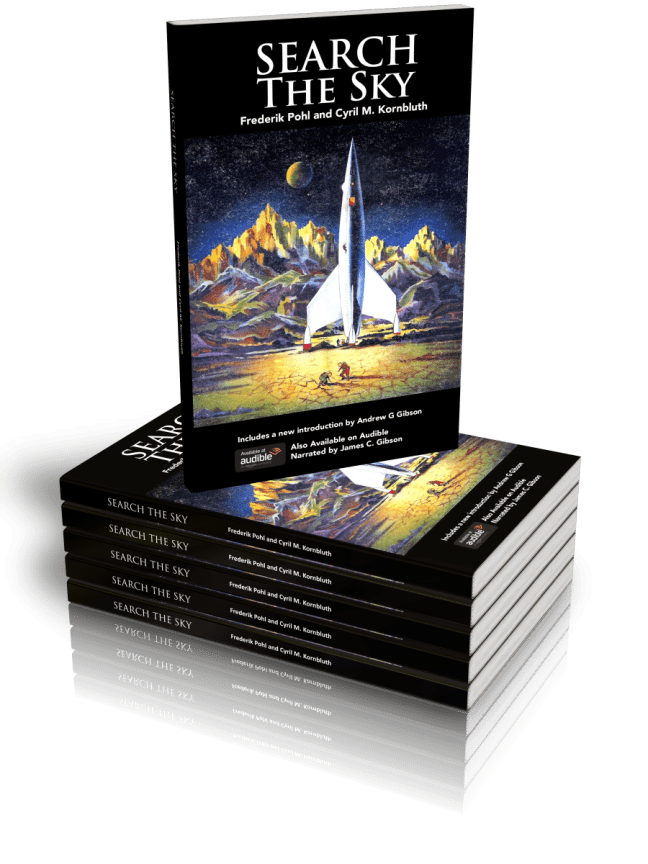
“Search the Sky” by Frederik Pohl and C.M. Kornbluth

Affiliate disclosure: Some links on this page are paid links. As an Amazon Associate I earn from qualifying purchases, at no extra cost to you.
Press Play to Listen to this Article!

“Search the Sky,” a science fiction masterpiece by Frederik Pohl and C.M. Kornbluth, offers a deep exploration into the complexities of interstellar colonization. First published in 1954, the narrative follows Ross, a resident of Halsey’s Planet, who is tasked with an urgent mission to investigate the decline of other human colonies. What sets this story apart from other space travel narratives is its incorporation of faster-than-light travel, a technological advancement that adds a unique layer of complexity to the genre. This feature allows the story to transcend typical space travel limitations, opening up a broader canvas for the authors to explore intricate societal and psychological themes. The novel serves as a compelling lens through which to examine human psychology, societal structures, and the moral quandaries that come with technological progress.

Plot Summary

The plot centers around Ross’s mission, which is made possible by a specialized spacecraft equipped for faster-than-light travel. This technological marvel enables him to traverse vast interstellar distances in a relatively short period, allowing him to visit multiple colonies facing unique challenges. From colonies governed by authoritarian regimes to those paralyzed by societal apathy, Ross’s journey becomes a rich tapestry of human experience. The authors use these diverse settings to delve into a myriad of human behaviors and societal challenges, making the plot a multifaceted exploration of the human condition. The urgency of Ross’s mission adds a layer of tension to the narrative, making each discovery and interaction crucial to the overarching quest to understand the decline of human civilization across the stars.

Themes

  1. Human Nature and Society: Search the Sky offers an in-depth examination of human nature’s dual role in both the formation and decay of societies. Each colony Ross visits serves as a microcosm of human behavior and governance, reflecting both the strengths and weaknesses inherent in humanity. The novel scrutinizes how human nature can be both a catalyst for societal growth and a hindrance, leading to stagnation or even decline.
  2. Technology and Dependence: The novel provides a critical look at society’s over-reliance on technology, particularly focusing on the ethical implications of advanced space travel technologies like faster-than-light crafts. It questions whether such advancements truly serve humanity or lead to unforeseen complications that could threaten the fabric of society.
  3. Existential Crisis: The declining populations across colonies serve as a metaphor for a broader existential crisis. The story raises poignant questions about the purpose and sustainability of human expansion into space, making the reader ponder the ethical and existential implications of colonization.

Characters

  • Ross: Ross is a complex character who undergoes significant personal growth throughout his journey. His transformation from a somewhat naive individual to a seasoned traveler adds a relatable human element to the story’s grander themes. His experiences and interactions with various colonies provide valuable insights into the complexities of human nature and society.
  • Secondary Characters: The individuals Ross encounters in each colony are not mere placeholders but complex, multi-dimensional characters. They each contribute to the story’s thematic richness, offering different perspectives on the central issues and adding layers of complexity to the narrative.

Writing Style

Frederik Pohl and C.M. Kornbluth employ a prose style that strikes a balance between readability and thematic depth. The pacing is well-calibrated, allowing for immersive world-building without sacrificing the narrative’s momentum. Dialogue is used effectively to reveal character motivations and to provide insights into the various societies Ross encounters. The authors’ ability to weave complex themes into a compelling narrative makes the book a rewarding read for those interested in both the science fiction genre and the study of human behavior.

Conclusion

“Search the Sky” is a compelling and thought-provoking read that offers a multifaceted look at human nature, societal complexities, and the ethical implications of advanced space travel technologies. Its intricate plot, well-developed characters, and deep thematic undertones make it a timeless classic in the science fiction genre. The novel serves as a mirror reflecting the complexities of human nature and society, making it a must-read for anyone interested in exploring the ethical and psychological dimensions of human existence.

Search the Sky Featured Image.
Cover art of "The Man Who Folded Himself" by David Gerrold, a seminal work that intricately explores the paradigms of time travel and the fluidity of personal identity.

“The Man Who Folded Himself”: Time Travel and Identity Unraveled

Affiliate disclosure: Some links on this page are paid links. As an Amazon Associate I earn from qualifying purchases, at no extra cost to you.

Published in 1973, “The Man Who Folded Himself” by David Gerrold is an audacious exploration of time travel and personal identity. The novella has been regarded as a hallmark of speculative fiction, one that sidesteps traditional paradoxes associated with time travel to dive into the deeper philosophical and existential issues that such a concept naturally invokes.

The Time Belt: A Device Beyond Measure

The central plot device, the “time belt,” allows the protagonist, Daniel Eakins, an unprecedented ability to travel through time. Unlike many time-travel devices in other narratives, this one allows Daniel not just to revisit past moments but also to encounter alternate versions of himself. This facet enables Gerrold to move beyond simplistic “cause and effect” paradoxes and examine more intricate, self-referential paradoxes.

Get it on Amazon!

A Multitude of Selves

What sets “The Man Who Folded Himself” apart is its relentless focus on the self. In most time-travel stories, the protagonist is warned not to interact with their past or future selves; here, that’s virtually the entire plot. Gerrold challenges our notions of individuality and identity by making Daniel confront, converse with, and even form relationships with different versions of himself from various timelines. For instance, at one point, Daniel attends a party exclusively populated by his alternate selves, each one representing a decision made or path taken.

The Fluidity of Identity

The novella is daring in its treatment of sexuality and personal relationships. The various Daniels form intimate relationships with one another, making the story a groundbreaking exploration of sexual fluidity long before such concepts entered mainstream discourse. Gerrold challenges our social constructs, suggesting that identity is not a fixed point but a spectrum, influenced by time, choice, and context.

Ethical Implications

The book doesn’t shy away from the ethical implications of time travel. When one possesses the ability to reshape history according to their whims, what is the moral compass guiding those choices? The lines between self-interest and altruism blur as Daniel grapples with the enormity of his newfound power.

The Tug of Fate and Choice

One of the fascinating threads in the novella is the tension between fate and free will. Despite having the power to alter events, Daniel comes to recognize certain “fixed points” in his life—moments that appear immutable, which adds a layer of tragedy to his omnipotence.

Gerrold’s Contribution to Science Fiction

David Gerrold, already known for his script for the classic “Star Trek” episode “The Trouble with Tribbles,” solidified his place in the science fiction pantheon with this novella. He not only explores the “what-ifs” of time travel but also delves into the existential crises that would inevitably accompany it.

Conclusion: An Ever-Unfolding Enigma

“The Man Who Folded Himself” offers more than just a time-traveling escapade; it provides a mirror reflecting our inner complexities. By disrupting linear time and the singular self, Gerrold questions the very notions that anchor our understanding of reality. The result is a story that, much like its protagonist, perpetually unfolds into new and unexpected shapes.

Get the Series on Amazon!
A portrait of Alan Moore, the iconic writer who challenged traditional comic storytelling with works like "Watchmen" and "V for Vendetta."

Alan Moore: The Enigmatic Visionary Who Transformed Comics into High Art

Affiliate disclosure: Some links on this page are paid links. As an Amazon Associate I earn from qualifying purchases, at no extra cost to you.
Press Play to Listen to this Article!

A prolific writer with a bushy beard and piercing eyes, Alan Moore, born on November 18, 1953, in Northampton, England, is far from your average comic book writer. Moore has been a transformative force in the world of comics and graphic novels, elevating the medium to levels of critical respectability it had never before achieved. His works challenge not just the boundaries of the comic book form but also societal norms and political structures.

The Early Journey into Comics

Alan Moore began his journey as a cartoonist and writer during the British comics boom of the late 1970s. Contributing to anthologies like “2000 AD,” he caught the eye of the American comic book industry. However, it was in the 1980s that Moore made an indelible mark on comics with groundbreaking works like “V for Vendetta” and “Swamp Thing,” both of which defied the limitations of genre to offer nuanced social and political commentaries.

Deconstructing the Superhero Mythos

Moore’s most famous work, “Watchmen,” co-created with artist Dave Gibbons, deconstructed the very concept of the superhero. Set in an alternate America, the complex narrative dissects issues of power, morality, and identity, while also employing a sophisticated structure, including documents, flashbacks, and even a comic within a comic. It was among the first graphic novels to be taken seriously by mainstream literary critics, thereby altering the perception of comics as mere children’s entertainment.

“From Hell” to “Promethea”

His other renowned works include “From Hell,” a deeply researched and chillingly plausible retelling of the Jack the Ripper murders, and “Promethea,” an exploration of mythology and the occult. Both titles have been lauded for their in-depth research and intricate plotting, signifying Moore’s willingness to immerse himself in diverse realms of knowledge to enrich his storytelling.

Sociopolitical Undertones

Moore’s work is never devoid of a political edge. From the anti-fascist sentiments in “V for Vendetta” to the commentary on environmental decay in “Swamp Thing,” his stories act as microcosms of larger societal issues. This political consciousness imbues his narratives with a sense of urgency and gravity, making them resonate beyond the confines of their pages.

A Magician and an Outsider

Interestingly, Moore considers himself a ceremonial magician, which influences his works’ recurring themes of reality, perception, and spirituality. He is also a notorious industry outsider, often critical of how big corporations like DC Comics and Marvel have commercialized and diluted the art form he holds dear.

Impact and Legacy

Alan Moore officially retired from comics in 2016, but his legacy endures. His works are still read, studied, and debated, continuously finding new audiences while intriguing the old ones. Despite his often reclusive and enigmatic nature, Moore remains one of the most analyzed and discussed figures in the history of comics.

Beyond the Page

Alan Moore remains a fascinating enigma of a man who challenged, and changed, how we understand a medium often dismissed as trivial. His work continues to be a touchstone for discussions about the intersection of art, politics, and culture, securing his position as one of the most influential writers of his time.

Graphic showcasing the 'Incredible Science Fiction: Amazing Tales from the 1950s and Beyond' series. The image features a collection of classic science fiction book covers arranged in a collage, capturing the essence of the golden era of the genre. The covers vary in color and design, depicting futuristic landscapes, space explorations, and intriguing characters. The series title is prominently displayed in bold, retro-inspired typography, set against a backdrop of stars and galaxies. A sense of nostalgia and wonder emanates from the image, inviting readers to embark on a literary journey through time and imagination."
Get the Series on Amazon!
An artistic representation that captures the essence of both classic science fiction and innovative storytelling. It could depict a vintage typewriter with sci-fi elements intertwined, such as a spaceship hovering above it or futuristic cityscapes reflected in its keys. The typewriter symbolizes the narrative craftsmanship of the past, while the sci-fi elements evoke the genre's futuristic allure. The image would be bathed in a nostalgic yet futuristic color palette, invoking a sense of wonder and curiosity. This combination of elements would visually convey the merging of classic narrative techniques with the imaginative landscapes of science fiction, inviting readers to embark on a journey of literary exploration.

Narrative Innovation: Narrative Structures in Classic Sci-Fi

Affiliate disclosure: Some links on this page are paid links. As an Amazon Associate I earn from qualifying purchases, at no extra cost to you.
Press Play to Listen to this Article!

Introduction: The Artistry of Science Fiction Storytelling

In the realm of science fiction, storytelling is an art that extends beyond the mere conveyance of ideas. It’s a dynamic interplay of words that transports readers into uncharted territories of imagination. The 1950s emerged as a golden era for the genre, birthing iconic tales that continue to resonate today. Yet, beneath the surface of these celebrated narratives lies an equally fascinating world of narrative innovation—techniques that authors of that era deftly employed to weave suspense, mystery, and intrigue into their stories. As the curator, narrator, and editor of the “Incredible Science Fiction: Amazing Tales from the 1950s and Beyond” series, I’ve ventured into the narrative landscapes of the past to explore the methods that authors used to captivate their audiences. In this exploration, we uncover the narrative structures that defined the era and still influence the genre’s evolution.

The Power of Narrative: A Driving Force in Science Fiction

Narrative structure isn’t just a scaffolding for a story; it’s the very backbone that shapes how readers experience the narrative. In science fiction, it becomes an essential tool to evoke emotions, provoke thought, and craft a sense of wonder. Authors of the 1950s understood this power and harnessed it to create tales that resonated with readers then and now. From the enigmatic depths of space exploration to the intricacies of futuristic technologies, these narratives wove webs of words that captured the essence of the human spirit’s yearning for the unknown.

The Quest for Novelty: Experimentation in Narrative

The 1950s was a time of creative exploration, both in scientific endeavors and artistic expression. Authors seized this opportunity to experiment with narrative structures, breaking away from conventional norms. In doing so, they engaged readers in new and unexpected ways. Stories like “The Demolished Man” by Alfred Bester defied linear chronology, immersing readers in a non-sequential experience that mirrored the intricate depths of the human psyche. This experimentation breathed life into the stories, infusing them with a sense of unpredictability that mirrored the mysteries of the cosmos they explored.

Crafting Suspense: Nonlinear Narratives and Flashbacks

Suspense is the lifeblood of many science fiction narratives, and authors of the 1950s mastered the art of keeping readers on the edge of their seats. Nonlinear narratives and skillfully executed flashbacks became tools to manipulate time, revealing fragments of the puzzle at precisely the right moments. In “Fahrenheit 451” by Ray Bradbury, the narrative structure mimics the internal turmoil of the protagonist, Montag, as he grapples with the dystopian world he inhabits. By playing with time, authors could unravel secrets layer by layer, creating an immersive experience that compelled readers to uncover the truth alongside the characters.

Puzzles of the Mind: Unreliable Narrators and Multiple Perspectives

The human mind is a labyrinth of perceptions, biases, and uncertainties. In the realm of classic sci-fi, authors embraced the complexity of human psychology by introducing unreliable narrators and multiple perspectives. Philip K. Dick’s “Do Androids Dream of Electric Sheep?” challenged readers to question reality alongside the protagonist, who struggles with distinguishing between human and artificial entities. By allowing readers to navigate the story through the lens of an unreliable narrator, authors tapped into the enigmatic nature of perception itself, inviting readers to discern truth from deception.

Unveiling the Unknown: Epistolary Narratives and Found Footage

The allure of the unknown has driven many science fiction tales, and authors in the 1950s found innovative ways to convey it through epistolary narratives and found footage elements. In “I Am Legend” by Richard Matheson, the narrative unfolds through diary entries, amplifying the isolation and desperation of the last human survivor in a post-apocalyptic world. The intimacy of this form immerses readers in the character’s psyche, making their journey all the more poignant. Found footage, reminiscent of modern cinematic techniques, offered a glimpse into events from different perspectives, creating an immersive sense of discovery.

Echoes of the Future: Parallel Timelines and Time Loops

The concept of time has long fascinated humanity, and classic sci-fi authors embraced its complexities with parallel timelines and time loops. These narrative devices allowed for exploration of alternate realities and the intricacies of cause and effect. Isaac Asimov’s “The End of Eternity” envisions an organization that controls time travel to manipulate history, leading to unforeseen consequences. By intertwining timelines, authors could explore the profound implications of even the smallest actions, sparking contemplation about the nature of destiny.

The Influence of Film Noir: Atmospheric Settings and Psychological Depth

The 1950s saw an interplay between science fiction and the aesthetics of film noir, influencing both narrative structures and themes. The use of atmospheric settings, shadowy characters, and psychological depth added layers of complexity to stories. In “The City and the Stars” by Arthur C. Clarke, the city of Diaspar becomes a character in itself, embodying the themes of isolation and exploration. This fusion of genres expanded the narrative possibilities, blending the intrigue of noir with the boundless horizons of science fiction.

Conclusion: The Legacy of Narrative Innovation

The narrative structures of classic science fiction in the 1950s were not

just techniques; they were pathways into the unknown, conduits that allowed readers to traverse the realms of imagination. From nonlinear chronology to unreliable narrators, these methods enriched the genre, transforming stories into journeys of discovery. As we reflect on these narrative innovations, we honor the ingenuity of authors who dared to break conventions and shape the very fabric of science fiction. The echoes of their storytelling brilliance continue to reverberate through time, inspiring both creators and enthusiasts to venture into uncharted narrative territories.

Buy Incredible Science Fiction on Amazon!
A retro-futuristic collage. It could incorporate iconic imagery from the 1950s sci-fi genre, such as vintage rocket ships, robots, futuristic cityscapes, and otherworldly landscapes. The design might include elements like old magazine covers, illustrations, and typography that evoke the period's aesthetic. This visual fusion would resonate with the series' theme, connecting the past's vision of the future with the contemporary reader.

Incredible Science Fiction: A Journey through Time with “Amazing Tales from the 1950s and Beyond”

Affiliate disclosure: Some links on this page are paid links. As an Amazon Associate I earn from qualifying purchases, at no extra cost to you.
Press Play to Listen to this Article!

The annals of science fiction are replete with imaginative stories that have not only entertained readers but also inspired generations of writers, scientists, and thinkers. In an exciting development, sci-fi enthusiasts can now delve into a treasure trove of classic stories through the series, “Incredible Science Fiction: Amazing Tales from the 1950s and Beyond.” Available on Amazon, this series beckons readers to explore a world where anything is possible.

A Look at the Collection

Curated with care, this series brings together a selection of timeless tales from the golden age of science fiction. The 1950s were a seminal era in the genre, marking a period where writers dared to imagine futures filled with space travel, artificial intelligence, and other fantastical concepts. This collection showcases the creativity and innovation that made this era a cornerstone of science fiction literature.

Each volume within the series offers a unique blend of narratives that engage the mind and stir the imagination. From the contemplative to the thrilling, these stories cover a wide range of themes that continue to resonate today.

The Importance of Preservation

What makes “Incredible Science Fiction: Amazing Tales from the 1950s and Beyond” stand out is its commitment to preserving and celebrating the rich heritage of vintage science fiction. Many of the stories included in this series have become difficult to find in print, and this collection serves as a valuable resource for both new readers and longtime fans.

The series not only entertains but educates, providing insight into the cultural and historical contexts that shaped these narratives. Readers can appreciate how these stories reflect the hopes, fears, and aspirations of a time when humanity was on the brink of unprecedented technological advancements.

Accessibility and Convenience

Available through Amazon’s Kindle Direct Publishing (KDP), this series offers unparalleled accessibility to a wide audience. Readers can easily navigate between volumes, making it a user-friendly experience that appeals to both seasoned bibliophiles and those new to the genre.

The use of digital platforms ensures that these classic tales are readily available to a global readership. Whether you prefer to read on a Kindle device or through the Kindle app on other gadgets, the series brings these masterpieces to the palm of your hand.

A Treasure for Science Fiction Enthusiasts

For those who appreciate the wonder and intrigue of science fiction, “Incredible Science Fiction: Amazing Tales from the 1950s and Beyond” is a must-have collection. It serves as a nostalgic trip down memory lane for longtime fans and an inviting gateway for newcomers.

With its thoughtful curation and commitment to preserving the legacy of the genre, this series embodies a celebration of creativity and human imagination. It invites readers to step into worlds where the boundaries of reality are challenged, and the extraordinary becomes ordinary.

In an age where the future often feels uncertain, these tales offer a reminder of the boundless potential of human ingenuity. As we continue to grapple with our place in the universe, the stories within this series provide a thoughtful and entertaining exploration of what it means to be human in a world where anything is possible.

Incredible Science Fiction: Amazing Tales from the 1950s and Beyond is more than just a collection of stories; it’s a journey through a rich and vibrant literary landscape that continues to inspire and delight. Don’t miss the opportunity to explore these classic tales – a universe of wonder awaits.

The perfect featured image for a review of "The Worshippers" by Damon Knight would be an evocative visual that encapsulates the main themes of the story. It might depict the towering statue of Weaver, the central character, half-carved from a monolithic block of stone, with the tiny robot aircar hovering near, chiseling away. In the foreground, a thoughtful or cunning look in Luke's eyes, and in the background, a distant, alien skyline under a clear blue sky. The image's palette would favor cold and stone-like colors, symbolizing the rigid control and cold calculation present in the story, contrasted with the warmth of the sky, representing the higher forces at play. This image would intrigue readers, hinting at the profound themes and tensions explored in the story.

Divinity in Disguise: A Thoughtful Analysis of “The Worshippers” by Damon Knight

Press Play to Listen to this Article!

“The Worshippers,” a compelling short story by Damon Knight, opens a window into the complexities of power, human arrogance, and the unexpected consequences of dominance. Set against a backdrop of an alien civilization, it portrays the journey of Algernon Weaver, whose godlike status reveals a chilling truth that ultimately leads to his downfall. Through its rich thematic tapestry, the story offers profound reflections on control, betrayal, cultural imperialism, and the fragility of power.

Themes and Symbolism

The Delusion of Divinity

Weaver’s elevation to godhood appears to be a triumph of human ingenuity and control. However, this illusion is skillfully deconstructed, culminating in a sobering realization that dominance is ephemeral. The symbolism of the statue being constructed in Weaver’s likeness, and the eventual revelation that the worship was merely amusement, creates a poignant commentary on the nature of power.

The Cycle of Betrayal

From reverence to betrayal, Weaver’s relationship with the aliens is a complex and unsettling progression. The shock of discovering that the aliens never truly worshiped him, but rather found him entertaining, speaks to a universal truth about the often misunderstood nature of power and influence.

Imposing Culture and its Repercussions

Weaver’s cultural imposition upon the alien race can be seen as a metaphor for colonialism. The theme is further emphasized by the arrival of another alien race, highlighting the cyclical nature of imperialism and its inherent instability.

Character Depth and Interaction

Algernon Weaver: A Misunderstood Conqueror

Weaver’s transition from a revered figure to a tragic victim underscores the fickle nature of power and the vulnerability that often accompanies it. His tragic end is a reminder of the fragility of human ego and control.

Luke: The Catalyst of Reality

Luke, the alien who interacts with Weaver, serves as a counterpoint to Weaver’s emotional journey. His pragmatic approach reveals the cold logic that ultimately seals Weaver’s fate, making him a pivotal character in the unfolding drama.

Literary Style and Narrative Tone

The story’s rich descriptions and honest dialogue engage the reader, while the tonal shift from optimism to despair reflects Weaver’s emotional arc. Symbolism is used effectively, enhancing the reader’s understanding of the underlying themes.

Conclusion: “The Worshippers” as a Reflection of Power and Identity

Damon Knight’s “The Worshippers” offers an insightful and tragic exploration of power, control, and human arrogance. Its themes resonate with contemporary issues, making it a timeless piece of science fiction. The story’s conclusion offers a jarring reflection on the nature of dominance and the unpredictability of human (or alien) reactions.

However, the portrayal of the alien race could benefit from more depth, as they remain somewhat enigmatic throughout the story.

This story is included in Incredible Science Fiction: Amazing Tales from the 1950s and Beyond Volume 2, a collection that highlights the richness and diversity of science fiction during a transformative era for the genre.

“The Worshippers” stands as a masterful commentary on the god complex, where divinity is a mere illusion, and the conqueror is as fragile as the conquered. It is a must-read for those interested in an intellectual exploration of power and cultural imposition within the world of science fiction.